Depression and Substance Use: Why Integrated Treatment Matters
Living with depression that doesn't respond to treatment is exhausting in a way that's hard to explain. You get out of bed, try to push through, maybe even see a therapist or start a medication, and still find yourself sliding back to the same place. Effective depression treatment exists and works, but many people receive care that addresses only part of what's happening. This article walks through proven options (therapy, medication, and advanced interventions) and explains why the overlap between depression and substance use fundamentally changes the treatment picture.
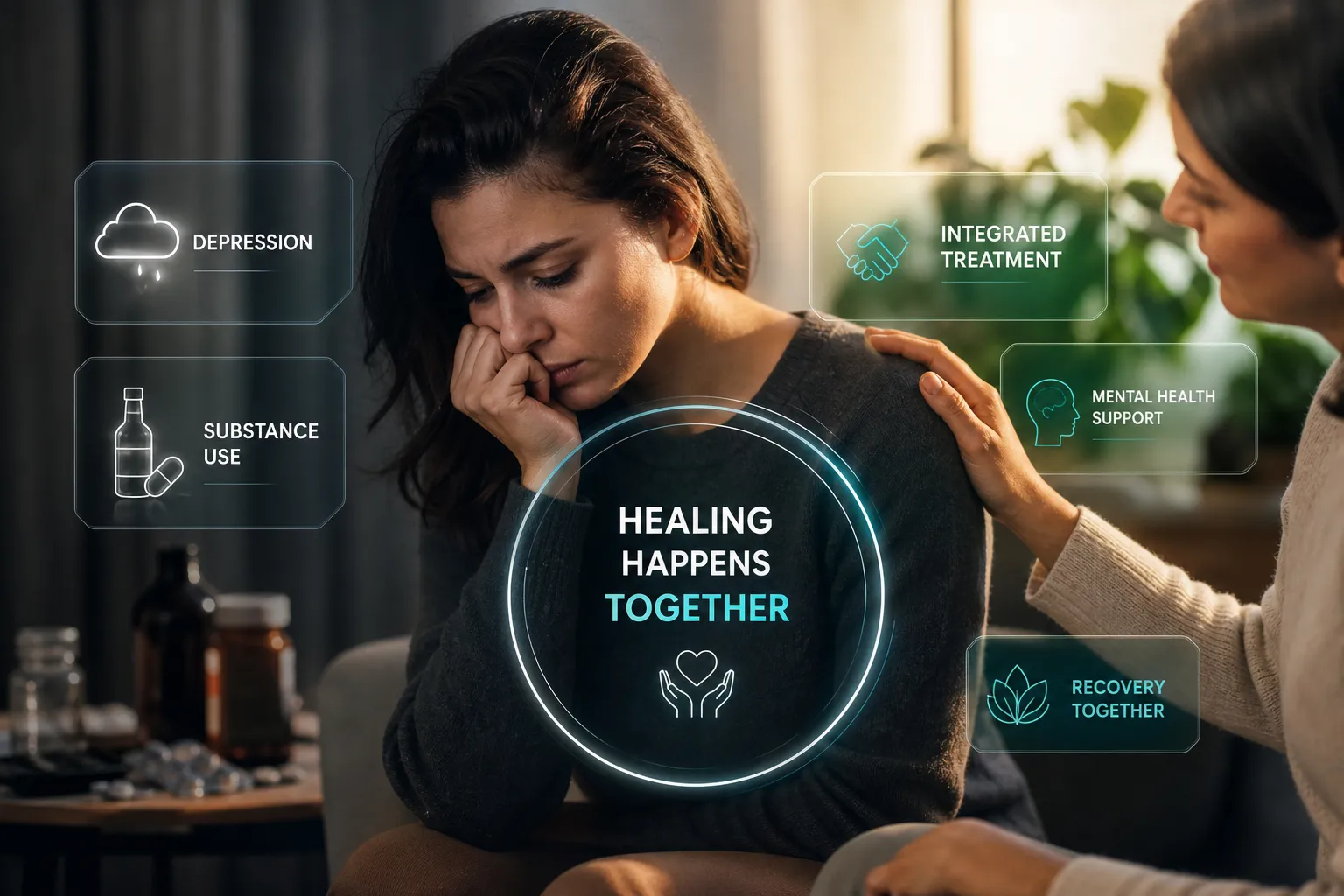
The reason fragmented care falls short is straightforward: depression rarely travels alone. Roughly one in four adults with major depressive disorder also meets criteria for a co-occurring substance use disorder. When that combination goes unaddressed, treating only one side leaves the other pulling the recovery apart. Understanding the full range of depression treatment options is the first step toward care that actually holds.
What first-line depression treatment actually looks like
One of the most persistent myths about treating depression is that there's a right answer you're supposed to already know. The reality is that clinical guidelines from the APA, AAFP, and VA/DoD all place evidence-based psychotherapy and antidepressant medication on equal footing as first-line options for adult major depressive disorder. The choice between them is driven by symptom severity, what you've tried before, your preferences, and what's actually accessible to you. Neither is automatically superior.
For mild to moderate depression, either therapy or medication as a standalone is clinically appropriate. For moderate to severe depression, combination treatment often outperforms either alone. Knowing this upfront saves people from cycling through inadequate depression treatment because they didn't realize more was available.
The psychotherapy options worth knowing about
Not all therapy is the same, and the label "talk therapy" doesn't tell you much. Cognitive behavioral therapy (CBT) is one of the most researched approaches; it works by identifying and restructuring thought patterns that maintain depressive states. Interpersonal therapy (IPT) focuses on the relationship between depression and life events like grief, conflict, or major transitions. Behavioral activation is more direct: it rebuilds engagement with meaningful activities when depression has flattened motivation to near zero.
Mindfulness-based cognitive therapy (MBCT) rounds out the frontrunners, and it's particularly valuable for people with recurrent depression. Its strongest evidence is in relapse prevention, which matters enormously for anyone who has recovered from depression before and wants to stay that way. CBT and MBCT both have solid track records for reducing the risk of future episodes, not just easing the current one. These psychotherapy for depression approaches aren't interchangeable, the right fit depends on your history, your goals, and how depression is currently showing up in your life.
How therapy compares to medication in real outcomes
Meta-analyses consistently show that psychotherapy and antidepressants produce roughly similar response and remission rates for mild-to-moderate depression. Where therapy holds a distinct advantage is in durability: its effects tend to persist after treatment ends, while medication protects most strongly while it's being taken. If you stop medication without building other coping skills, you lose that protection. Therapy builds something you keep.
For more severe depression, combining therapy and medication typically outperforms either approach alone. The most practical takeaway is that these two options complement each other more than they compete. Integrated depression treatment, using both simultaneously, is often the most complete path forward.
Antidepressant medications: what to expect and watch for
Most people starting an antidepressant carry two quiet fears: that it will change who they are, and that stopping it will be miserable. Both deserve a direct answer. Antidepressants are clinical tools, not personality modifiers. While individual experiences vary and any concerns should be discussed openly with a prescriber, their benefits are measurable and the decision to start or stop is always one you make with a clinician rather than alone.
SSRIs and SNRIs as the typical starting point
SSRIs, like sertraline and escitalopram, and SNRIs, like venlafaxine and duloxetine, are the most commonly prescribed first-line antidepressants. Bupropion and mirtazapine are also listed in VA/DoD guidance as first-line options, depending on the clinical picture. Early changes often appear within two to four weeks, most commonly in sleep quality, appetite, or energy level before mood itself lifts. Full therapeutic response usually takes six to eight weeks, sometimes longer.
Not responding to the first medication is not a sign that medication won't work. It's often a signal that a different agent or a different dose will. Many people reach remission on their second or third trial, a pattern supported by sequential treatment research, which is why persistence in the process matters as much as starting it.
Side effects, discontinuation symptoms, and safety signals
Common side effects include nausea, sleep disruption, headache, sweating, and sexual dysfunction. GI symptoms often improve over the first few weeks for many patients. Sexual side effects tend to persist longer and are worth naming with your prescriber, because options exist.
Stopping abruptly is where problems often arise. Discontinuation symptoms, including dizziness, brain zaps, flu-like feelings, and irritability, occur when medication is discontinued abruptly rather than tapered. Two specific safety considerations deserve mention: serotonin syndrome is a rare but serious risk when SSRIs or SNRIs are combined with other serotonergic drugs, and bleeding risk increases when these medications are taken alongside NSAIDs like ibuprofen. The FDA also requires a black box warning about monitoring for mood changes, particularly early in treatment or after dose adjustments. These aren't reasons to avoid medication; they're reasons to stay in communication with your prescriber.
When standard treatments aren't enough: advanced options for harder cases
If you've already tried therapy, tried medication, and still haven't found relief, it's easy to conclude that you're the problem. You're not. Treatment-resistant depression is a recognized clinical category, defined as inadequate response after two or more antidepressants tried at therapeutic doses for sufficient duration. It has specific, effective treatment pathways, not a dead end, but a different door.
How treatment-resistant depression is defined and approached stepwise
Before escalating depression treatment, clinicians are trained to reassess the situation: confirm the diagnosis, rule out bipolar disorder, and check whether the medication was actually taken at therapeutic dose for enough time. Many people escalate too quickly without fully optimizing what they're already on. The standard sequence moves from optimizing the current regimen to switching antidepressant classes, then to combination or augmentation strategies, and finally to specialty referral for advanced interventions.
TMS, ECT, and intranasal esketamine: what each one is
Three FDA-approved advanced options exist for treatment-resistant depression, and none of them are last resorts. They're specialized tools with distinct clinical roles. TMS (transcranial magnetic stimulation) is noninvasive, outpatient, and FDA-cleared for treatment-resistant depression; response rates in typical practice hover around 50%, and it doesn't require anesthesia.
ECT (electroconvulsive therapy) is the most effective acute intervention for severe or life-threatening depression, with the strongest track record overall, though it requires anesthesia and carries short-term cognitive side effects. Intranasal esketamine works rapidly, often within hours to days, and is administered under clinical supervision for both treatment-resistant depression and acute suicidal ideation. Knowing these options exist matters. Many people exhaust standard depression treatment options without ever learning that structured, evidence-based next steps are available through specialty care.
The depression-substance use cycle, and why treating one isn't enough
This is the part most care plans miss. Depression and substance use don't just co-exist, they reinforce each other in a loop that's neurologically real. Many people discover alcohol or other substances because they genuinely blunt emotional pain in the short term. That's not a character flaw; it's brain chemistry responding to distress. Over time, however, substance use alters that same chemistry in ways that deepen depression.
How each condition makes the other worse
Alcohol is a depressant. It disrupts sleep architecture, worsens mood regulation over time, and gradually erodes the emotional stability that therapy is working to rebuild. Stimulant use creates mood crashes. Opioids dysregulate the reward system in ways that make ordinary pleasures feel flat. When someone is using substances regularly, antidepressants are often fighting against the current rather than with it.
Approximately 20 to 25 percent of U.S. adults with major depressive disorder also meet criteria for a co-occurring substance use disorder, and those with both conditions consistently show worse outcomes when only one is treated.
What integrated care actually looks like in practice
Integrated dual diagnosis treatment, where a clinical team addresses both depression and substance use in the same program, generally produces better mental health outcomes than sequential treatment, though results vary across studies and populations. Sequential care, treating addiction first and then depression or vice versa, leaves one condition working against the other during the delay. Programs that treat both simultaneously are better aligned with what the evidence supports for most people with co-occurring conditions.
Honor Behavioral Health in Boise offers a dual diagnosis track built around this integrated model. As a local resource for adults in the Treasure Valley, the program provides structured clinical support through an Intensive Outpatient Program (IOP) or Partial Hospitalization Program (PHP), allowing people to stay embedded in their daily lives, work, family, and community, throughout treatment. That kind of real-life continuity matters. It's the difference between care that fits your life and care that requires stepping away from it entirely. Honor Behavioral Health holds Joint Commission accreditation and maintains SAMHSA alignment; individuals are encouraged to verify program specifics and confirm coverage directly when reaching out.
Lifestyle changes that reinforce any treatment plan
Clinical treatment is the foundation, but what happens between sessions matters too. Lifestyle interventions aren't replacements for therapy or medication. They're evidence-informed additions that support depression management and self-care, helping to accelerate recovery and reduce relapse risk.
Sleep, exercise, and daily structure as clinical inputs
Exercise is the most consistently evidence-supported lifestyle intervention for depression. Some studies show effects comparable to medication for mild-to-moderate symptoms, particularly with supervised aerobic or resistance training. The practical starting point isn't a training plan, a 20 to 30 minute walk most days is a realistic, meaningful entry. Sleep hygiene matters because disrupted sleep is both a symptom and a driver of worsening depression. Consistent wake times, regular meals, and light daily activity create the behavioral scaffolding that antidepressants and therapy build on.
Social connection and reducing isolation
Depression narrows the social world through fatigue, low motivation, and shame, and that narrowing makes depression worse. Observational research suggests that maintaining even one consistent relationship or social touchpoint during a depressive episode carries protective effects worth taking seriously. Family psychoeducation programs, peer recovery communities, and group therapy formats all serve this function within a treatment context. Isolation isn't a neutral state; it's a risk factor that needs to be named and addressed directly.
Recognizing when depression needs urgent attention, and your next steps
Most articles about depression stop before the most important part: when to stop managing and start treating it as an emergency. There are clear clinical markers, and knowing them can be lifesaving.
Warning signs that go beyond typical depression symptoms
Seek same-day care when depression includes active suicidal ideation with or without a specific plan, psychotic features like hallucinations or delusions, or a complete inability to maintain basic functioning, eating, drinking, or getting out of bed for days. Worsening depression while already on medication also warrants immediate contact with a clinician. Calling 988, the Suicide and Crisis Lifeline, is a practical option and is not limited to people who are at immediate risk of acting. If you're unsure whether what you're experiencing qualifies, that uncertainty is reason enough to call.
How to take the first step toward depression treatment
Contact a primary care provider, a psychiatrist, or an outpatient behavioral health center and ask for an intake assessment. Before that call, note how long symptoms have been present, what you've already tried, and whether substance use is part of the picture. Name everything. Integrated programs can only help when the full picture is visible, and the right program won't use that information against you. Many providers offer insurance verification by phone before your first appointment, it's worth asking, because navigating coverage questions upfront removes one of the most common reasons people delay starting.
Depression treatment works best when care is complete
Depression treatment is not a single lever. It's a combination of therapy, medication, lifestyle support, and for some people, advanced clinical interventions, matched carefully to what the person in front of the clinician actually needs. No single option works for everyone, and not responding to the first thing you try doesn't mean you're out of options.
For people navigating both depression and substance use, the most important thing to understand is that both conditions are treatable, and they're most effectively treated together. You don't have to pick which one deserves attention first. The right care addresses both, with the same team, in the same program, from the same starting point.
If you're in the Treasure Valley and ready to talk to someone about what that kind of care looks like, Honor Behavioral Health is here. What you're carrying is real, and the support you need exists.
Learn more about Co-occurring mental health and addiction care, Depression treatment.